Wednesday, January 21, 2015

How can I relate classical art to my own art?


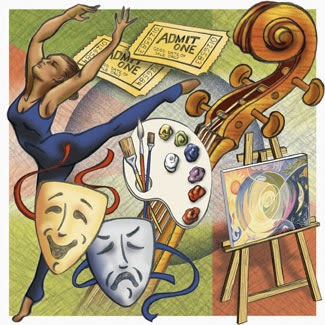
Art history has always been a fascinating subject. Reading about it and studying the many forms of art, one can gain knowledge of how modern art emerged from the influences of the classical art period. Art now is no longer confined to historical architectures or various artworks in museums but has expanded into different fields such as music, dance and literature. However, these modern forms of art would not be possible if it weren’t for the artistic legacy of Greece and Rome. The art that they passed down inspired many modern artists with their specific genre of philosophy that gives emphasis on society.

 The art of the ancient Greeks and Romans comprise what is called classical art. The term was also used during the later periods in which artists searched for inspiration from this ancient style for their craft. The Classical period of Ancient Greece, spans most of the 5th and 4th century BC. Greek artists of this era were able to portray the vitality of life as well as a sense of stability, clarity, and harmony in their works. In 146 BC, Rome was conquered by Greece. During this time, the Greek art was intermixed with that of Rome. Though most of the Romans’ art were borrowed, the art forms demonstrated their passion and dominating spirit especially in the area of architecture.

My brother introduced me to Greek and Roman mythology when I was 10 years old. I became really interested and amazed by their architecture. I often wondered how they were able to construct those magnificent structures during those early times. Ever since then, my artistic style was further influenced by classical art. I admired the Greeks for their extensive attention to detail as well as their idealistic preferences. The Parthenon is definitely one of my favorite. I commend the Romans for their practicality and focus on realism. An example of that would be the Coliseum. One day, I hope to create my own style that both balances idealism and practicality of the classical period. I also look forward to how classical art would influence artists of the future generations.


Classicism. (n.d.). Wikipedia, The Free Encyclopedia. Retrieved January 19, 2015 from http://en.wikipedia.org/wiki/Classicism

Classical Greece. (n.d.). Wikipedia, The Free Encyclopedia. Retrieved January 19, 2015 from http://en.wikipedia.org/wiki/Classical_Greece

Roman art. (n.d.). Wikipedia, The Free Encyclopedia. Retrieved January 19, 2015 from http://en.wikipedia.org/wiki/Roman_art

Various Authors. (n.d.). GREEK AND ROMAN ART. history-world.org. Retrieved January 19, 2015 from http://history-world.org/arthist.htm

Classical Art History. (n.d.). artapprenticeonline.com. Retrieved January 19, 2015 from http://www.artapprenticeonline.com/artstudies/apprentart/edacclhistory.html

Freeman, G. (2011, July 8). Classical Art: Greece and Rome. slideshare.net. Retrieved January 19, 2015 from http://www.slideshare.net/gwfreeman/classical-art

Hemingway, C., & Hemingway, S. (n.d.). The Art of Classical Greece (ca. 480–323 B.C.) . metmuseum.org. Retrieved January 19, 2015 from http://www.metmuseum.org/toah/hd/tacg/hd_tacg.htm


Images from:
knox.libguides.com
thinglink.com
oneonta.edu


Monday, January 5, 2015

Ancient Art


Since the dawn of mankind, art has always been part of history. Art history is a chronological sequence of different types of art ranging from the prehistoric times to the current twenty-first century. The earliest forms of art (that was found) were from the Stone Age. Time progressed and the early people started building civilizations. This paved the way to the evolution of art known as Ancient Art. According to some, Ancient Art dated back to 3000 B.C.E. up to 400 C.E., from the ancient civilizations such as those of ancient Egypt, Mesopotamia, China, Israel, Persia, India, Greece and Rome. These civilizations contributed many art treasures that helped shape various form of art for the future generations.

The emergence of these early civilizations, along with the use of written languages and the development of more sophisticated tools, led to the creation of countless historical arts. Ancient Egyptian art forms for example, are represented by consistent and detailed illustrations of gods, people, heroic battles and nature. Also, most of their surviving works of art were designed to provide consolation and service to the departed in the afterlife. Mesopotamia is often referred to as the cradle of civilization due to being the first area where complex society developed. Mesopotamia brought significant cultural developments, including the oldest examples of writing. The art of Mesopotamia rivalled that of Ancient Egypt as the most grand, sophisticated and elaborate in western Eurasia. Their art was centered on various, very durable, forms of sculpture in stone and clay. Chinese art is based from Chinese heritage and culture. Chinese art has arguably the oldest continuous tradition in the world. However, there were also big changes in Chinese art. For example, when Chinese people learned about Buddhism, under the Han Dynasty, they also discovered about Buddhist art styles in India, and Chinese sculptors learned to make life-size stone statues. Other ancient societies like Greece and Rome were also renowned for their art that includes pottery, sculpture as well as architecture.

Art will continue to change as time passes, which is why it is important for us to learn from the arts of our ancestors so we can develop our own aesthetic interpretations. Every one of us has their own individual perspective of what is appealing. We classified art based on what we saw from past artistic creations in terms of the design elements such as color, texture, shape and value. We also made comparisons and contrasts between different artists and their contributions to further improve our knowledge about art. By having explored the rich and fascinating history of ancient arts, we discovered millennia of wonderful compilation of human experience. I’m looking forward to what the future will bring into the world of art.


References:


Ancient Art. (n.d.). Wikipedia, The Free Encyclopedia. Retrieved January 3, 2015 from http://en.wikipedia.org/wiki/Ancient_art

Art of Ancient Egypt. (n.d.). Wikipedia, The Free Encyclopedia. Retrieved January 3, 2015 from http://en.wikipedia.org/wiki/Art_of_ancient_Egypt

Art of Mesopotamia. (n.d.). Wikipedia, The Free Encyclopedia. Retrieved January 3, 2015 from http://en.wikipedia.org/wiki/Art_of_Mesopotamia

Chinese Art. (n.d.). Wikipedia, The Free Encyclopedia. Retrieved January 3, 2015 from http://en.wikipedia.org/wiki/Chinese_art

Chinese Art History. (n.d.). Historyforkids.org. Retrieved January 3, 2015 from http://www.historyforkids.org/learn/china/art

Art History Appreciation. (n.d.). Arthistory.net. Retrieved January 3, 2015 from http://www.arthistory.net/

Ancient Art. (n.d.). Visual-arts-cork.com. Retrieved January 3, 2015 from http://www.visual-arts-cork.com/ancient-art.htm


Images from:

Google Images


Wednesday, December 10, 2014

The importance of art elements and principles of design


Art is similar to a machine in the sense that it also has different parts or components. For a machine to function well, the parts have to be complete and in good working condition. In art, the different components are applied in order to form a concept as basis for a work of art. Both art and machine came from the ideas of a creative mind and were made for a purpose. However, the similarity between the two ends here. A machine is defined as any tool that aids in performing a task. It is a cold and lifeless mechanical device which functions in a standardized or predictable manner. Art, on the other hand, is any craft or creative work requiring skill. It has different forms and is unpredictable because it is conceived in the mind and created according to the perception of the artist. The five senses, touch, smell, taste, sight and hearing, are used to breathe life into an artwork.

Art is seen everywhere. From schools, streets, houses, museums, galleries, media, etc. We are exposed to it since childhood until our adult life. We may have seen the various forms of expressions in art but our inexperienced eyes will not be able to see and recognize the disparity between an ordinary work randomly made and the genuinely designed pieces of artwork. Only those who knew and studied the principles of design can tell the difference based on the composition and elements used by the individual artist.        

As a multimedia student, I believe that it is necessary to learn and understand the basics of art. In my opinion, the art elements and principles of design are important because these are the fundamental substance needed to create artworks that are orderly, consistent, balanced and visually appealing to the viewers. This is made possible through the arrangement of structural elements of design and the use of technical skills and methods to balance the image.


The visual arts are a way of expressing the emotional perceptions, beliefs or preferences of an individual artist. The components of art such as content and form makes up for the entirety of a work of art with its subject matter (the main theme chosen by the artist), the organization of the elements used and the underlying meaning or message. In creating artworks, diversity in style is sometimes linked to cultural backgrounds while the media and techniques used are usually preferred by the artists. The design principles helped bind together individual elements harmoniously, highlight essential elements and create a connection between all parts of the work of art.


Images from:

arttherapyblog.com

wallpaperswide.com

Sunday, November 30, 2014

My Own Artistic Style


Art has always been a part of my life. I have loved art even as a child. I started drawing when I was four years old. Just like other children of my age, my early forms of art were pictures of houses and people around me. When I was six years old, I started watching anime on the television. I was amazed by the different colors, effects and designs of the characters. This became my favorite style of art and since then, I have drawn numerous illustrations of anime characters. I still continue to draw whenever I have the time and in doing so, it has helped me improve my drawing skills.

As I got older, I was exposed to other kinds of art like photography, music, and films. These helped me to further expand my artistic style. I became a fan of visual effects as filmmakers were able to produce movies with realistic environments. Another aspect that has made a huge impact in my artistic preferences is 3D animation. I was constantly fascinated by how they were able to generate movements and make them look as if they were real. When listening to music, I get concepts and inspiration for my artworks through the lyrics and melody. Music videos are another form of art that introduced me to a different angle of creative thinking. I also admire photography, because it conveys emotions, stories and perspectives through still images.

Through all of these experiences with art, I can say I have improved a lot and the designs for my artworks keep on changing and evolving. As for now, I have no definite style. Although I have to keep myself updated with current trends, I believe that making designs and artworks depends a lot on the individual’s taste and the kind of message he/she wants to convey. Nowadays, I use grunge and dark colors in my artworks. My artistic style at present may be considered as unorthodox but I always try to be more versatile as an artist. This is due to the fact that I am still growing and learning in my craft. I also get inspiration from other well-known artists such as Tetsuya Nomura, Masashi Kishimoto, Pablo Picasso, Vincent Van Gogh, Leonardo da Vinci, etc. In the future, I hope to become a successful artist with my own distinct style.


Image from:
freestockphotos.name

Monday, November 24, 2014

Mona Lisa: Da Vinci's Masterpiece


Leonardo di ser Piero da Vinci was an Italian polymath born on April 15, 1942. A polymath is a person whose expertise varies in several fields of study. Da Vinci is a scientist, sculptor, architect, mathematician, draftsman, engineer, inventor, musician, anatomist, geologist, cartographer, botanist, and writer. However, he was most renowned mainly as a painter. Among his greatest works are: The Last Supper, which is perhaps the most reproduced religious painting of all time, and the Mona Lisa, arguably the most famous painting in the world. Mona Lisa is also called the “La Gioconda” by the Italians meaning “a light-hearted woman”, but the French refer to it as “La Joconde”. The Mona Lisa is an oil painting done by Da Vinci on a poplar wood panel sometime between 1503 and 1506, when he was living in Florence, Italy, and it now hangs in the Louvre, in Paris. The painting presents a woman with an iconic smile in half-body portrait, which has a landscape background. The reason behind the fame of the Mona Lisa is the mysterious smile on the woman’s face, in which the exact nature of the smile cannot be determined. Da Vinci managed to capture so many different emotions and character-traits in one painting that whenever one looks at Mona Lisa; one sees something different depending on which direction the painting is looked at. He continuously worked on the Mona Lisa, completing it technically in 1507, but his death in 1519 finally ended his work on it.

Da Vinci may have been the greatest portraitist of all time. The Mona Lisa painting was among the first portraits to illustrate the sitter before an imaginary landscape and he was one of the first painters to use aerial perspective to create the illusion of depth. Leonardo was a scientist and from his study of the human anatomy, he applied what he knew to give the Mona Lisa realism. He effectively created a visual impression of distance between a seated female figure and the observer. The woman sits upright with her arms folded and her gaze is fixed on the observer. The armrest of the chair functions as a dividing element between Mona Lisa and the viewer. Behind her is a vast landscape of mountains, valleys and rivers. The sense of overall harmony achieved in the painting reflects the idea of a link that connects humanity and nature. Leonardo da Vinci created the dark mood and smoky colors that added to Mona Lisa’s charm. He had applied techniques and elements new to the era. Da Vinci perfected the technique known as sfumato, which comes from the Italian word “sfumare”, meaning “to tone down” or “to evaporate like smoke”. His painting technique used mostly earthy browns, greens and blues in muted intensity that unites the elements in the painting.

Leonardo da Vinci usually painted with oil paint that he made by hand from ground pigments; and later in his career, he worked with tempera made from egg whites. He would first start covering his canvass with a detailed underpainting in a neutral gray or brown color and apply dark transparent glazes on top to add a depth that could not be achieved otherwise. Some of the underpainting would show through the layers subtly helping to create form. He did not use bold colors or tints in contrasting colors which explains why the Mona Lisa’s lips and eyes are so pale. The use of sfumato in the Mona Lisa gave the painting an illusion of somberness and mystery. Da Vinci’s soft gentle lighting was essential to his paintings. Facial features were not strongly defined but conveyed by soft, blended variations in tone and color. He has created vague transitions between light and shade and sometimes between colors, his brush strokes so faint as to be invisible to the naked eye. The gauzy veil, Mona Lisa’s hair, and the luminous glow of her skin, are all created with layers of transparent color, giving the painting an ethereal, almost magical quality.

Leonardo da Vinci has only about a dozen or so paintings in existence today, because of his revolutionary techniques. However, from the surviving da Vinci paintings we are able to understand a little more about his painting style. Few paintings are so well known as da Vinci’s Mona Lisa and her popularity and status as a reputable work of art continues to intrigue people. Because it’s difficult to view all the portrayed emotions and aspects of Mona Lisa’s personality in one glance, one is left with a sense of mystery. “Giorgio Vasari, for example, wrote in his early biography of da Vinci, Lives of the Painters: “As art may imitate nature, she does not appear to be painted, but truly of flesh and blood. On looking closely at the pit of her throat, one could swear that the pulses were beating.” We may never know who sat for the portrait of Mona Lisa or what she’s smiling about but the Mona Lisa looks so natural, and so familiar, that we forget how ingenious the painting was because it went against all the trends of the time. Although the painting is a perfect example of how Leonardo never followed traditions, the Mona Lisa has set the standard for all future portraits and became an enduring record of Leonardo’s vision.


References:

Polymath. (n.d.).  Wikipedia, The Free Encyclopedia. Retrieved November 23, 2014 from http://en.wikipedia.org/wiki/Polymath

Leonardo da Vinci. (n.d.). Wikipedia, The Free Encyclopedia. Retrieved November 23, 2014 from http://en.wikipedia.org/wiki/Leonardo_da_Vinci

Mona Lisa. (n.d.). Wikipedia, The Free Encyclopedia. Retrieved November 23, 2014 from http://en.wikipedia.org/wiki/Mona_Lisa

Sfumato. (n.d.). Wikipedia, The Free Encyclopedia. Retrieved November 23, 2014 from http://en.wikipedia.org/wiki/Sfumato

The Editors of Encyclopædia Britannica. (2014, August 22). Mona Lisa. Britannica.com. Retrieved November 23, 2014 from http://www.britannica.com/EBchecked/topic/388735/Mona-Lisa

Mona Lisa. (n.d.). lairweb.org. Retrieved November 23, 2014 from http://www.lairweb.org.nz/leonardo/mona.html


Evans, M. B. (n.d.). “The Mona Lisa” by Leonardo da Vinci. painting.about.com. Retrieved November 23, 2014 from http://painting.about.com/od/famouspainters/ig/famous-paintings/Leonardo-Mona-Lisa.htm

Lively, A. (n.d.). The Mona Lisa by Leonardo da Vinci: History, Facts & Location. education-portal.com. Retrieved November 23, 2014 from http://education-portal.com/academy/lesson/the-mona-lisa-by-leonardo-da-vinci-history-facts-location.html#lesson


Da Vinci’s Mona Lisa. (n.d.). leonardo-da-vinci.paintings.name. Retrieved November 23, 2014 from http://leonardo-da-vinci.paintings.name/


Evans, M. B. (n.d.). Palettes and Techniques of the Old Masters: Leonardo da Vinci. painting.about.com. Retrieved November 23, 2014 from http://painting.about.com/od/oldmastertechniques/a/LeonardodaVinci.htm


…Leonardo’s masterful technique. (n.d.). pbs.org. Retrieved November 23, 2014 from http://www.pbs.org/treasuresoftheworld/mona_lisa/mlevel_1/m3technique.html

Grey, L. (n.d.). Leonardo Da Vinci’s Life. davincilife.com. Retrieved November 23, 2014 from http://www.davincilife.com/article4-davinci-painting-technique.html


Images from:


en.wikipedia.org
leonardodavinci.net

Monday, November 17, 2014

The connection between art and history


Art has always been a part of our history. The first tangible artifacts of human art are found from the Stone Age (Upper Paleolithic, Mesolithic and Neolithic). During the Paleolithic (25 000-8000 BCE), man practiced hunting and lived in caves, where cave painting was developed. That method was also believed to be a form of communication. Art continued to change and evolve as time progressed. Early civilizations such as the Ancient Egyptians, the Ancient Chinese and the Mayans introduced a whole new world of art that changed history. For example, the Ancient Egyptians arose as one of the first great civilizations, with elaborate and complex works of art, which assume the professional specialization of the artist/craftsman. Its art was intensely religious and symbolic, with a highly centralized power structure and hierarchy, giving great importance to the religious concept of immortality, especially of the pharaoh, for whom were built great monuments. Other civilizations contributed into the evolution of art as well. They paved the way for the development of different branches of art such as music, literature and architecture that established different cultures.


Art has changed and transformed throughout the years. In modern times, art has expanded further into different forms including music, dance and visual arts. Music is the vocal or instrumental sounds combined in such a way as to produce beauty of form, harmony, and expression of emotion. Today, music is divided into various genres like pop, rock, classical, R&B and hip-hop. Dancing is the rhythmical movement to music, using steps and gestures. Early forms of dancing were used for religious offerings, celebrations, rituals. Today, dancing is mostly used for entertainment purposes which lead to the creation of different types of dance e.g. ballet, disco, street dance. Visual arts are produced mainly for visual perception and enjoyment as well as for intellectual purposes. It applies to both the fine arts (painting, sculpture, photography, etc.) and the applied arts (industrial, graphic, interior and fashion designs). As we can see, the concept of art is no longer traditional and it continues to change as people find new discoveries and meanings about art.


Art is closely connected with history because it helped shape the traditional roots of our cultures and gave them a distinct identity. In the future, I think art will be a lot different from what is now. It will be transformed into digital form. Everyone will be able to view and create art with the use of advanced technologies like those in science fiction movies. Art has no boundaries; it is only limited by our imaginations. I’m really looking forward to the time when mankind will bring forth a new kind of art. I would also like to thank our ancestors, whom without; we would not have known the wonderful gift that is “Art”. 


References:

Perez, V. History/timeline of dance 1900 – 2012. (2012, November 28). Prezi.com. Retrieved November 16, 2014, from https://prezi.com/nqqs1oqn4v34/historytimeline-of-dance-1900-2012/

Fine art. (n.d.). In Wikipedia, The Free Encyclopedia. Retrieved November 16, 2014 from http://en.wikipedia.org/wiki/Fine_art

Visual arts. (n.d.). In Wikipedia, The Free Encyclopedia. Retrieved November 16, 2014 from http://en.wikipedia.org/wiki/Visual_arts

History of art. (n.d.). In Wikipedia, The Free Encyclopedia. Retrieved November 16, 2014 from http://en.wikipedia.org/wiki/History_of_art


Images from:

http://stockarch.com/images/business-and-industry/art-design/art-2082
http://alpha.sd41.bc.ca/static.php?page=static110110-204537
http://img.gawkerassets.com/img/17vzt2aabxn07jpg/original.jpg

Tuesday, September 23, 2014

Living Quietly: What would happen to the world if there was no sound?


Sound is everywhere. Each morning we wake up, we can hear different sounds from our surroundings. Like the ringing of the alarm clock, music playing on a radio, chirping of birds, horns from cars passing by and neighbors talking. We have become accustomed to these sounds that the mere thought of living quietly with no sound is just unthinkable. But what if there was really no sound at all? What will happen to the world?

Having no sound would throw the whole world into chaos. No one will be able to communicate effectively, thus creating a chain reaction that will eventually affect everybody. People would have a hard time understanding each other and will cause confusion and frustration. Doctors, teachers, policemen, pilots and other professions wouldn’t be able to do their jobs properly, affecting those who need their services. The mass media, which serves as our tool of communication and information, will be very limited. Everyone will suffer as a result.

Aside from chaos, we will also experience dullness and boredom. Music and entertainment will have no meaning since we will not be hearing any sound. People will also be discouraged to start a conversation due to the fact that they won’t be able to express themselves or relay their messages effectively. Without sound, our lives will simply be empty. Lots of things will not be possible to do without sound. It is an important factor in our lives that we need in order to live and thrive.


Image from:

thelinuxexperiment.com